Skip to content
NG Operations
Lab and quality control

Laboratory quality control: from the customer’s specification to the certificate of analysis.

The lab closes the planning loop: before goods leave for the customer, you know whether the lot meets the customer’s specification. NG Operations manages methods, parameters and specifications, lot analyses with an automatic pass / fail check, and approval — and prints the certificate of analysis (CoA) in English from the approved analysis.

  • Customer specifications
  • Lot analysis
  • Sign-off and approval
  • CoA in English

Free consultation and a demo on your own processes.

The NG Operations planning cycle: Sales plan → Materials and packaging → Purchasing → Production plan → Laboratory → Customer delivery. NG WMS — the warehouse executes the plan: what arrives from suppliers, what gets produced, what goes to customers; actuals flow back into the plan.

In the application

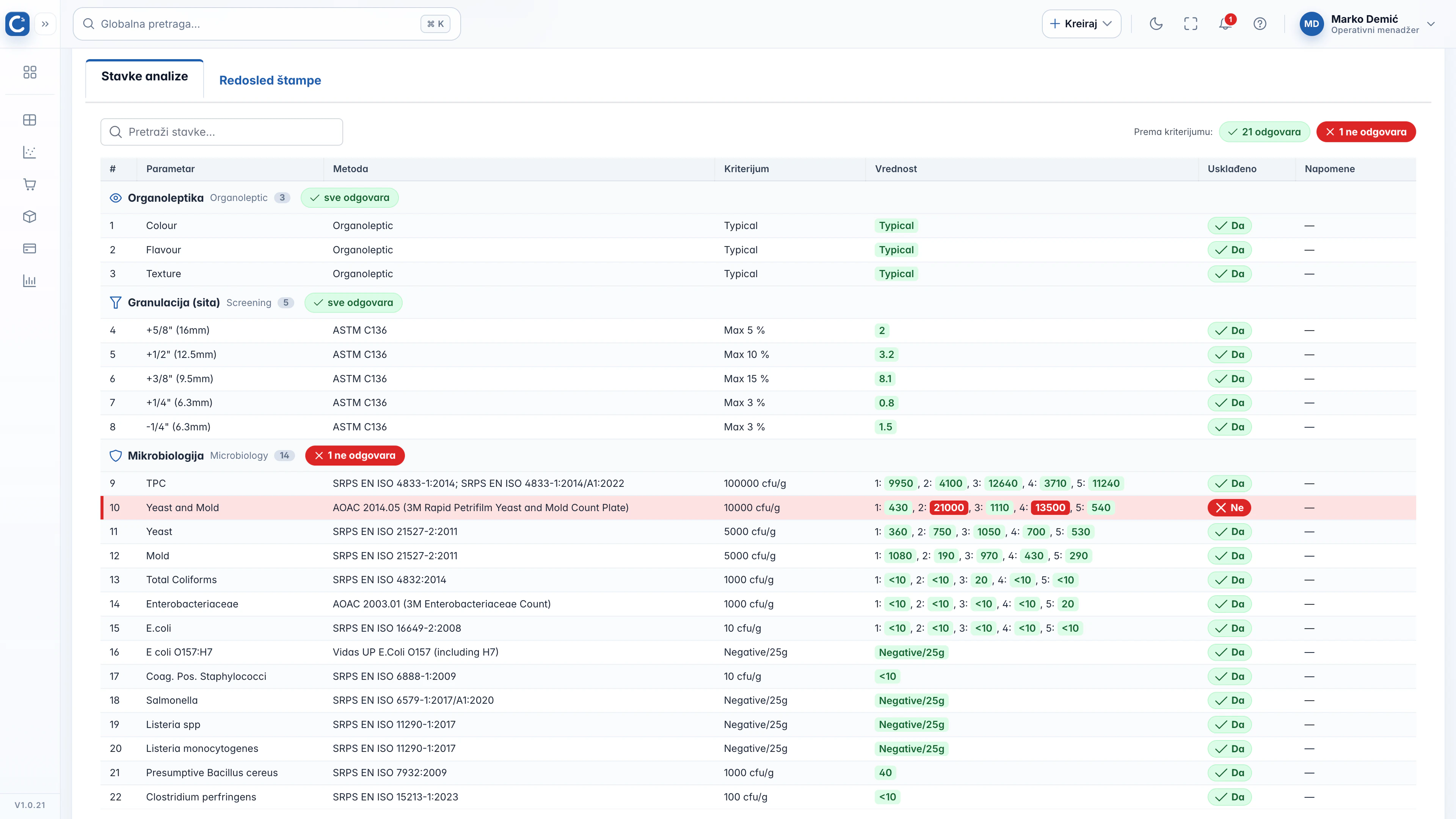
A laboratory analysis: 22 parameters in organoleptic, granulation and microbiology groups, with method, criterion, values per sample and a compliance verdict — 21 compliant, 1 non-compliant
A lot analysed against the customer’s specification: any value outside the criterion is flagged at once, with an overall verdict.Screenshot with fictional demo data. Click for full size.
Capabilities

What the lab does in NG Operations

What a production lab needs every day — in the same system as customer orders, the production plan and purchasing.

  • Methods, parameters and categories

    Methods with their standard, duration and equipment; parameters with unit, result type and number of measurements; and categories — physico-chemical, microbiological, sensory. A test report is assembled from prepared building blocks, not typed from scratch.

  • The customer’s specification as a template

    A template holds the parameters, a method for each and the acceptance criterion exactly as the customer writes it — and as it prints on the certificate. Every customer has its own specification, with a version number.

  • Analysis per lot

    Each analysis is kept for a lot, an item and a customer, with production date, best-before date and sample details. Choose the template and the parameters fill in on their own.

  • Automatic pass / fail check

    As the analyst enters a result, the system checks it against the criterion — maximum, minimum, range or “negative” — and proposes a verdict. Where a criterion cannot be read reliably, it does not guess: the analyst sets the verdict.

  • Sign-off, then approval

    The analyst signs off the complete analysis and the lab manager approves it. Who approved it stays on record; if the analysis is changed afterwards, the approval is cleared and has to be given again.

  • Certificate of analysis (CoA) in English

    The approved analysis prints as a Certificate of Analysis in PDF: product, lot, dates, specification and test result for every parameter, and the lab manager’s name. Until the analysis is approved, the PDF is marked “DRAFT – NOT APPROVED”.

  • Samples for external labs and customers

    A sampling record notes what was sent, from which lot, how much and to whom — and prints with “sample taken by” and “sample received by” signature lines.

  • Quality trend across batches

    The lab’s home page shows what is in progress, what is waiting for approval and what does not comply, and a chart of a parameter across recent batches draws the customer’s limit and highlights values outside it.

  • Lab dashboards

    Analyses by customer and specification, time to approval, delays, samples sent to labs and the parameters that most often miss the customer’s criterion.

How it flows

From specification to certificate

The lab is the last check before delivery: a lot goes to the customer with an approved analysis and a certificate.

  1. 01

    Master data

    Methods, parameters and categories are set up once. Anything no longer used is deactivated, not deleted, so older test reports stay intact.

  2. 02

    Customer specification

    A template with parameters, methods and acceptance criteria, plus the order in which parameters appear on the certificate.

  3. 03

    Lot analysis

    The analyst opens an analysis from the template, enters the lot, dates and sample details, then records results — several measurements per parameter where needed.

  4. 04

    Verdict

    Every value is checked against the criterion: green within the limit, red outside it, with the compliance verdict proposed automatically.

  5. 05

    Sign-off and approval

    The complete analysis is signed off and the lab manager approves it — only then does the certificate lose its draft marking.

  6. 06

    Certificate with the delivery

    The CoA, as a PDF in English, goes to the customer with the goods. A lot that does not comply can be put on hold by the warehouse in NG WMS, as a separate step.

Real-world scenario

What it looks like in a real plant

A situation every manufacturer knows — and how NG Operations runs it, step by step.

An export customer wants a CoA with every delivery

Illustrative example

The situation

A biscuit and wafer manufacturer exports to Germany. The customer has sent a specification with 12 parameters — moisture, water activity (Aw), fat, microbiology — and requires a certificate of analysis in English with every delivery, for each lot separately. Three lots ship this week.

The challenge

When test reports live in Word templates, the analyst copies the limits from the customer’s specification for every lot and types the certificate by hand, in English. One wrong limit or a mixed-up lot means a complaint — and the certificate often lags behind the truck.

How it runs in NG Operations

  1. 1The lab manager enters the customer’s specification once, as a template: parameters, a method for each and the criterion exactly as the customer writes it — “max 4.5%”, “Negative/25g”.
  2. 2For each lot, the analyst opens an analysis from the template; the parameters fill in on their own, and the analyst adds the lot, production date, best-before date and sample details.
  3. 3As results are entered, the system checks them against the criterion: values within the limit are green, values outside it red, and the compliance verdict is proposed automatically.
  4. 4Once all measurements are in, the analyst signs off the analysis, and the lab manager reviews and approves it.
  5. 5The approved analysis prints as a Certificate of Analysis in PDF, in English, with specification and test result for every parameter and the lab manager’s name.
  6. 6The certificate goes to the customer with the goods, and the number of analyses awaiting approval is visible on the lab’s home page — or you can ask NG Copilot.

Who does what

  • Lab analystRecords results and signs off the analysis.
  • Lab managerMaintains customer specifications and approves analyses.
  • Export salesSends the certificate to the customer with the delivery.

What you gain

The specification is entered once, every lot is judged the same way, and the English certificate comes straight from the approved analysis with no retyping — the customer gets the CoA with the goods, not after them.

See how this process works in NG Operations

Illustrative example: the numbers are an example, the steps are the actual workflow in NG Operations.

A lot fails one parameter before loading

Illustrative example

The situation

A cosmetics manufacturer fills hand cream into 75 ml tubes. A retail chain’s truck is due on Thursday, and on Wednesday the lab analyses lot 2611-B — pH, viscosity, appearance, odour and microbiology — against the customer’s specification.

The challenge

Without a system, an out-of-spec result sits in the lab notebook until somebody asks. The goods are in the warehouse, ready to load, so they can easily leave before anyone reads the result — and pulling goods off the shelves costs far more than one moved date.

How it runs in NG Operations

  1. 1The analyst enters the results: viscosity is 9,200 mPa·s, while the customer’s specification requires 10,000–14,000. The value turns red and the verdict is “does not comply”.
  2. 2The analysis appears straight away among the non-compliant ones on the lab’s home page; the lab manager informs quality, production and sales the same day.
  3. 3The warehouse puts the lot on hold in NG WMS with a document and a reason — as a separate step — so the lot cannot be loaded.
  4. 4The planner adds a new work order to Wednesday afternoon’s plan, and sales moves the loading date to Friday; purchasing, packaging and production confirm the new date before sales gives it to the customer.
  5. 5The new lot is analysed, the analyst signs it off, the manager approves it, and the certificate is printed for the lot that actually ships.
  6. 6Quality and production decide what happens to the lot on hold, and the analysis with its verdict stays on record with that lot.

Who does what

  • Lab analystRecords results and sees the deviation immediately.
  • Quality managerDecides on the lot on hold and approves the new lot’s analysis.
  • SalesMoves the loading date and gives the customer a realistic date.

What you gain

The deviation shows the moment the result is entered, not after loading. The out-of-spec lot does not reach the customer, the new date is agreed with every department, and the customer gets goods with a certificate that matches the lot delivered.

See how this process works in NG Operations

Illustrative example: the numbers are an example, the steps are the actual workflow in NG Operations.

Incoming raw material checked before use

Illustrative example

The situation

An animal feed plant receives maize from several suppliers during harvest. Before it goes into production, every delivery is checked: moisture and foreign matter in the in-house lab, aflatoxin at an accredited external lab.

The challenge

When results are kept on paper, it is hard to say which delivery has been checked and which is still waiting for the external lab. Raw material with too much moisture or mycotoxin ends up in production, and the claim to the supplier has neither a lot nor a purchase order number.

How it runs in NG Operations

  1. 1Maize has a template with internal acceptance criteria: moisture at most 14%, foreign matter at most 2%, aflatoxin B1 below the set limit.
  2. 2When a truck arrives against a purchase order, the warehouse receives it in NG WMS, and the analyst takes a sample and opens an analysis with the lot from the receipt and the purchase order number.
  3. 3For aflatoxin, the analyst creates a sample marked for an external lab and prints the sampling record with “sample taken by” and “sample received by” signature lines.
  4. 4Moisture and foreign matter are entered straight away, and the external lab’s result when it arrives; for every parameter, the system proposes a verdict against the criterion.
  5. 5One delivery shows 15.2% moisture: the analysis reads “does not comply”, and the warehouse keeps that lot apart in NG WMS, with a document and a reason, until purchasing agrees the next step with the supplier.
  6. 6The claim goes to the supplier with the lot, the purchase order number and the approved analysis as evidence.

Who does what

  • Lab analystSamples deliveries and records results.
  • Warehouse managerKeeps the non-compliant lot apart.
  • PurchasingFiles the claim with the lot and purchase order number.

What you gain

For every delivery you know whether it has been checked and what the result was, out-of-spec raw material does not slip into production unnoticed, and the supplier claim rests on a document rather than memory.

See how this process works in NG Operations

Illustrative example: the numbers are an example, the steps are the actual workflow in NG Operations.

Quality closes the planning loop

The sales plan, materials, purchasing and production bring the goods to the loading date — the lab confirms that what goes to the customer meets the customer’s specification.

Quality before delivery

Purchasing, packaging, production and sales agree the loading date, and before loading, the lab approves the lot’s analysis and issues the certificate for the customer.

The lab judges, the warehouse holds

A “does not comply” verdict does not change stock by itself. When goods need to be held, the warehouse does it in NG WMS, with a document and a reason — deliberately, as a separate step.

Answers without digging through folders

“Which of Friday’s lots have no approved analysis?” The answer is on the lab’s home page, and NG Copilot gives it in plain words too, with the analysis behind each lot.

Frequently asked questions

Is this a LIMS?

The lab in NG Operations covers what manufacturers usually look for in a LIMS: methods and parameters, customer specifications, lot analyses with an automatic verdict, samples, sign-off and approval, and the certificate of analysis (CoA). The difference is that it sits in the same system as customer orders, the production plan and purchasing.

What does the certificate of analysis (CoA) show?

Product name, lot, production and best-before dates, the customer and delivery address, the purchase order number and report date, and for every parameter the method, specification and test result. The certificate is in English, and the name of the person who approved the analysis prints as “Laboratory manager”.

What happens when a lot fails?

A value outside the criterion turns red straight away and the verdict reads “does not comply”. The lab informs the people responsible; if goods need to be held, the warehouse does it in NG WMS, with a document and a reason. The lab verdict alone does not change stock in the warehouse.

Can each customer have its own specification?

Yes. A customer specification is a template — parameters, a method for each and an acceptance criterion — with a version number. When a limit changes for good, you change it in the template; on a single analysis, the criterion can be adjusted for that test report only.

How is incoming raw material checked?

Just like finished goods: create a template for the raw material with its own acceptance criteria, and keep the analysis per lot from the receipt, with the number of the purchase order the goods arrived on. When part of the sample goes to an external lab, the sampling record notes what was sent and to whom.

Who can approve an analysis?

A user with approval permission, and only once the analysis has been signed off. Their name stays on record and prints on the certificate. If the analysis is reopened after approval, the approval is cleared and has to be given again.

Does NG Copilot know the lab results?

Yes. NG Copilot also answers questions about lab results — for example, which lots still have no approved analysis — with the analysis the answer comes from. Sign-off and approval stay with the lab.

Related

  • Quality6 min read

    Certificate of analysis (CoA): what it contains and how it is issued

    Many customers, especially in export, won’t accept goods without a certificate of analysis (CoA) for each lot. What a CoA should contain, where the limits come from, why analysis is done per lot and who approves the document before it goes to the customer.

  • Quality7 min read

    Lot traceability and LIMS: quality that doesn’t hold production back

    Traceability is not a folder of paperwork but a data model linking a raw-material lot to a delivery to a customer. The recall test, the role of a LIMS, quality gates — and who does what between the plan, the warehouse and the laboratory.

Want to see how this would look in your production?

In a free consultation and demo we walk through your sales plan, materials and production in NG Operations and show how the plan connects to the warehouse.